Small Cells, Big Consequences
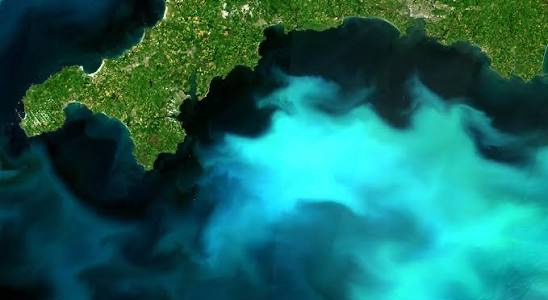
Coccolithophores are tiny marine phytoplankton, but they play an outsized role in the ocean. One species, Emiliania huxleyi, forms huge blooms and builds calcium carbonate plates called coccoliths. Through photosynthesis and calcification, these cells help move carbon through the ocean.
Their main opponent is a coccolithovirus called EhV. These viruses infect E. huxleyi blooms and can cause them to collapse. At first glance, this sounds entirely harmful. But this collapse is part of a larger cycle that helps regulate carbon movement in the sea. The coccoliths act as a shield against the viral attacks so heavily calcified cells are often harder to infect, while weakly calcified or “naked” cells are more vulnerable. But the virus has ways around this shield. Coccolithoviruses can interfere with calcification and trigger coccolith shedding.
The Hidden Conflict
EhV is not a simple virus. It carries genes involved in sphingolipid metabolism, which is unusual because viruses do not synthesize their own lipids. These viral genes help produce viral glycosphingolipids, or vGSLs.
During infection, vGSLs are linked to rising reactive oxygen species, or ROS, and caspase-like activity. These are signs of programmed cell death. Instead of simply bursting open, infected cells are pushed into a controlled death pathway. This helps the virus spread and contributes to bloom collapse.
Why It Matters
When a bloom collapses, the dead and dying cells do not just disappear. Infection increases production of transparent exopolymer particles, or TEP. These sticky particles help cells, coccoliths, and organic matter clump together.
Those clumps become marine snow, which sinks through the water column. Because coccoliths are made of dense calcium carbonate, they can help weigh down these particles and move carbon into deeper ocean layers.
If you're interested in reading more this is a short academic review of mine
Coccolithophore Review